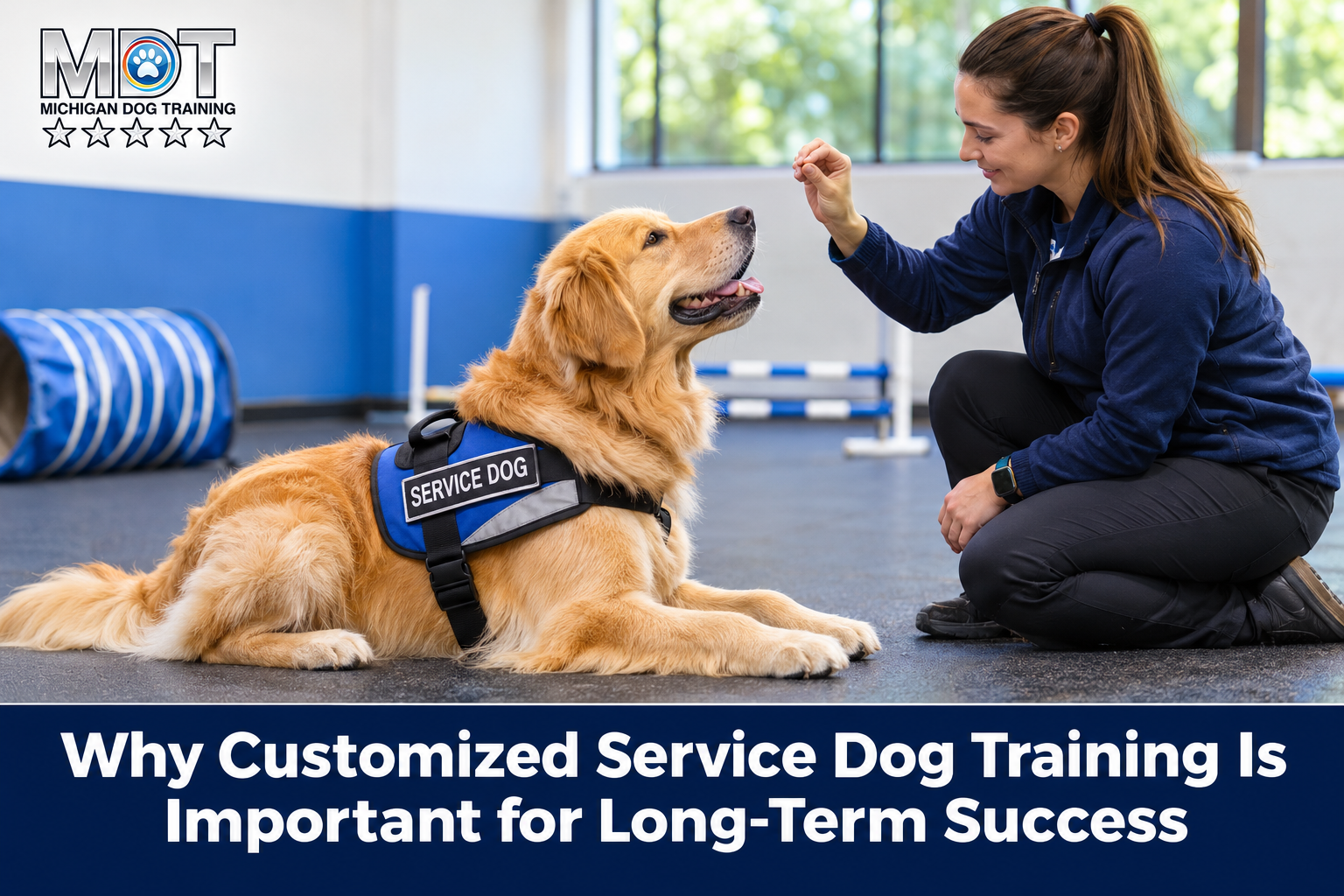
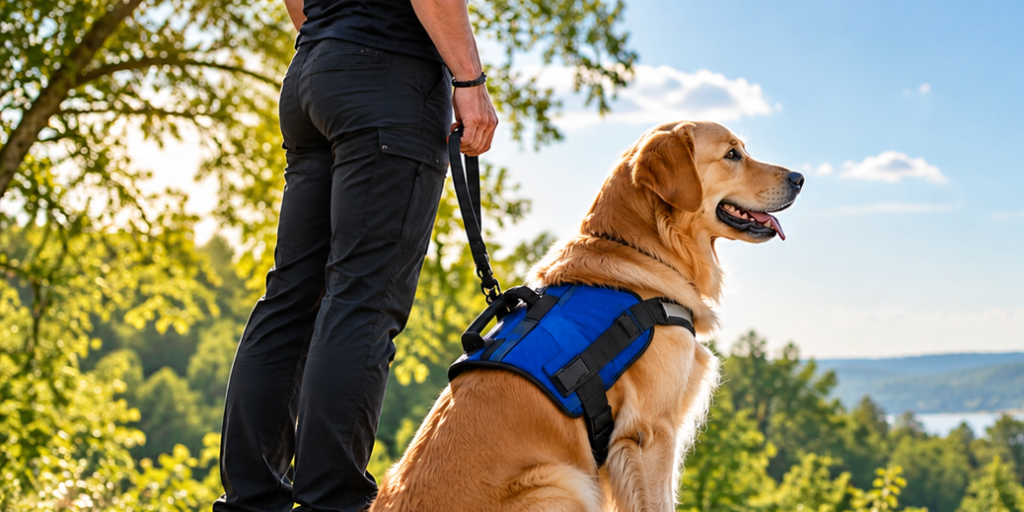
A service dog’s most important work often happens without attracting attention. It may retrieve an essential item, alert its handler to a sound, or remain composed in a crowded public space. Finding experienced service dog trainers in my area is an important step toward developing these practical skills. We approach service dog preparation as a process of building dependable behaviors that address an individual’s disability-related needs while supporting safe, consistent interactions in everyday life.
When families search for service dog training near me, they may already have a dog they hope to train or may be exploring their options for the first time. We believe the starting point should be understanding the handler’s needs, evaluating the dog’s suitability, and identifying the skills required to make the partnership functional.
What Separates a Service Dog From a Well-Trained Pet?
Good manners are essential, but service dog preparation involves more than basic obedience. Under the Americans with Disabilities Act (ADA), a service dog must be individually trained to perform work or tasks directly related to a person’s disability. Companionship alone does not meet this definition. The U.S. Department of Justice explains the requirements for service animals.
We therefore distinguish everyday obedience from disability-related task training. A dog may learn to sit, stay, walk calmly on a leash, and respond to its handler while also learning a specific task, such as retrieving a dropped object or responding to an important sound. These skills serve different purposes, and both contribute to a functional working partnership.
Why Must We Evaluate the Dog Before Choosing a Program?
Not every dog is suited to service work, regardless of breed or how strongly an owner feels connected to the animal. We consider temperament, physical health, confidence in unfamiliar environments, responsiveness to instruction, and the dog’s ability to recover from unexpected situations.
An evaluation also helps us understand the handler’s daily routine and intended tasks. Mobility assistance, hearing alerts, medical response, and tasks associated with psychiatric disabilities can involve different training requirements. The plan must reflect the dog’s capabilities and the handler’s actual needs.
Before selecting a training pathway, we look for several practical indicators:
- Comfortable, controlled behavior around people and other dogs.
- The ability to remain focused despite everyday distractions.
- Motivation to learn and work with the handler.
- Physical suitability for the intended tasks.
- An appropriate response to unfamiliar sounds, surfaces, and settings.
These indicators help guide the training decision, although an initial assessment cannot guarantee that a dog will ultimately qualify for service work.
How Does Public-Access Training Prepare Dogs for Real Life?
A service dog may perform a task successfully at home but struggle when the environment becomes more demanding. Busy sidewalks, shopping areas, restaurant seating, elevators, and unfamiliar sounds introduce distractions that require separate practice.
We build public-access skills gradually, according to the dog’s readiness. Training may include loose-leash walking, settling quietly beside the handler, ignoring food and unfamiliar people, and responding reliably to established cues. We also emphasize calm behavior and appropriate control around everyday activity.
The objective is not to make a dog interact with everyone it encounters. Instead, we work toward a dog that can remain focused on its handler and perform its trained responsibilities without unnecessary disruption.
What Do Disability Statistics Tell Us About Accessibility?
The Centers for Disease Control and Prevention reported in April 2025 that more than 61 million U.S. adults, or approximately one in four, reported having a disability, based on 2022 data. This figure represents disability broadly rather than demand for service dogs, but it illustrates the importance of understanding accessibility needs across communities.
We recognize that assistance needs differ from one person to another. For some handlers, retrieving objects or helping with daily routines may be valuable. Others may need trained hearing alerts or specific responses associated with a disability. Individualized planning helps connect training objectives to practical needs instead of applying the same task list to every dog.
Should Handlers Train Their Own Service Dogs?
Some handlers prefer to participate directly in training their own dogs, while others seek a more intensive professional training arrangement. We recognize that both approaches require consistent practice, realistic expectations, and an ongoing commitment to maintaining the dog’s skills.
Our service dog training options include an eight-week board-and-train program and a 20-lesson train-your-own-service-dog program. Depending on the selected pathway and individual suitability, instruction may include obedience, public-access preparation, disability-related tasks, and handler education.
Professional instruction does not remove the handler’s responsibility. Transfer lessons, daily practice, and continued reinforcement help the dog apply learned behaviors with the person who depends on them.
How Can We Maintain Reliability After Training?
A trained behavior must remain useful across different environments and changing circumstances. We encourage handlers to practice familiar cues regularly, reward appropriate responses, and recognize when a dog needs rest or a less demanding setting.
We also emphasize that a service dog’s abilities should be assessed honestly. Medical alert work, for example, cannot be assumed reliable simply because a dog responds to training. Tasks must be evaluated through appropriate practice, and a service dog should complement rather than replace prescribed medical care or equipment when applicable.
The ADA does not require service dogs to hold a particular certificate or complete professional training. Legal status depends on the applicable requirements, including performing trained disability-related tasks and remaining under appropriate control. A private certificate alone does not establish that status.
Turning Training Into a Practical Partnership
Reliable service dog work develops through individual assessment, purposeful instruction, public-access practice, and continued handler involvement. For people comparing service dog trainers in my area or researching service dog training near me, understanding the training process is just as important as comparing program formats.
Michigan Dog Training offers specialized service dog training in Plymouth, Michigan, with options for professional board-and-train instruction and handlers who want to train their own dogs. We encourage prospective clients to discuss their goals, the dog’s suitability, and the intended tasks before selecting a program.
Frequently Asked Questions
- What qualifies a dog as a service dog?
We look for tasks directly related to a person’s disability, plus reliable behavior and control.
- Can any dog become a service dog?
We assess temperament, health, confidence, and learning before recommending suitable service training for each dog.
- What is public-access training?
We practice calm movement, settling, focus, and responses around crowds, food, people, and common distractions.
- How long does service dog training take?
We set timelines based on program, task complexity, progress, and the handler’s practice between sessions.
- Does a certificate establish legal service-dog status?
We explain that ADA status depends on disability-related tasks and conduct, not certificates alone.