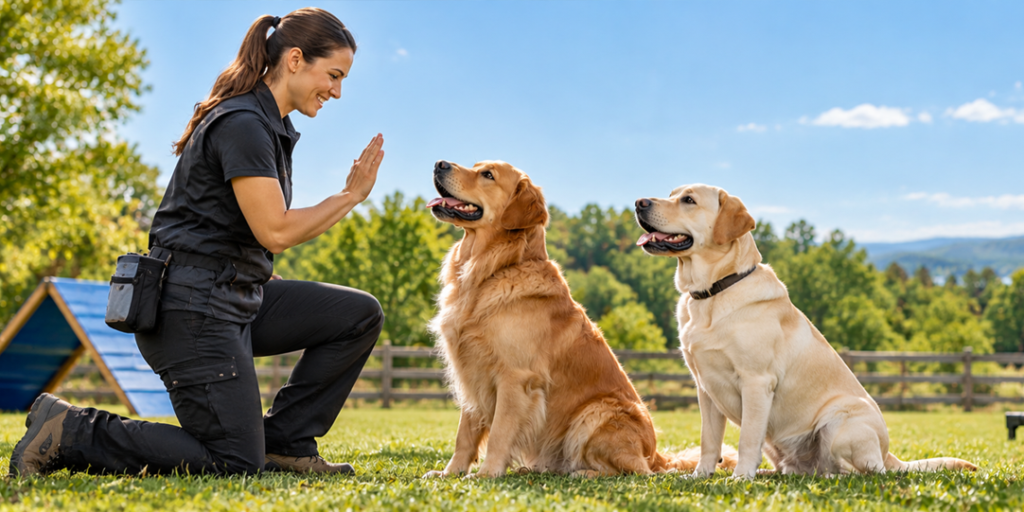
A dog who is well-behaved in a quiet room can show vastly different behavior when a squirrel walks across the street, someone knocks on the doorbell, or another dog approaches. These are the times that make you realize why dog training schools in Michigan should do more than the basics of obedience training. We feel that good training is about making good decisions in the situations a dog will find themselves in day-to-day life and developing habits that will help them with that.
When considering dog training in Bloomfield Hills, MI, the key question isn’t just how fast a dog can “learn” a command; it’s how they will learn it. That’s on whether that behavior translates to situations where life gets distracting. Training is an ongoing process of teaching, practicing, and reinforcing skills until they are more likely to be executed in other environments as well.
Why Does Real-World Training Matter More Than Perfect Commands?
Dogs learn by experience, repetition, and consequences. It’s possible for a dog to know the word stay at home but not when a stranger walks by. This doesn’t necessarily indicate that the dog does not know the command. Situations may be more difficult than the way they were learned in the past.
We progress towards reliability, gradually adding distractions. Training may start in a calm area, and then move to a busier area. Once the dog is comfortable with the command, we can lengthen the hold time, add distance to the command, or add other distractions.
This is the step toward understanding an important principle: You cannot learn to do a behavior and then do it well under pressure.
Which Skills Make Everyday Life Easier for Dogs and Owners?
Practical obedience helps dogs navigate household routines, neighborhood walks, and public environments. We focus on skills that support safe handling, clearer communication, and appropriate responses to common situations.
Depending on a dog’s needs, training may include:
- Recall: Teaching the dog to return when called, with practice appropriate to the environment and level of reliability.
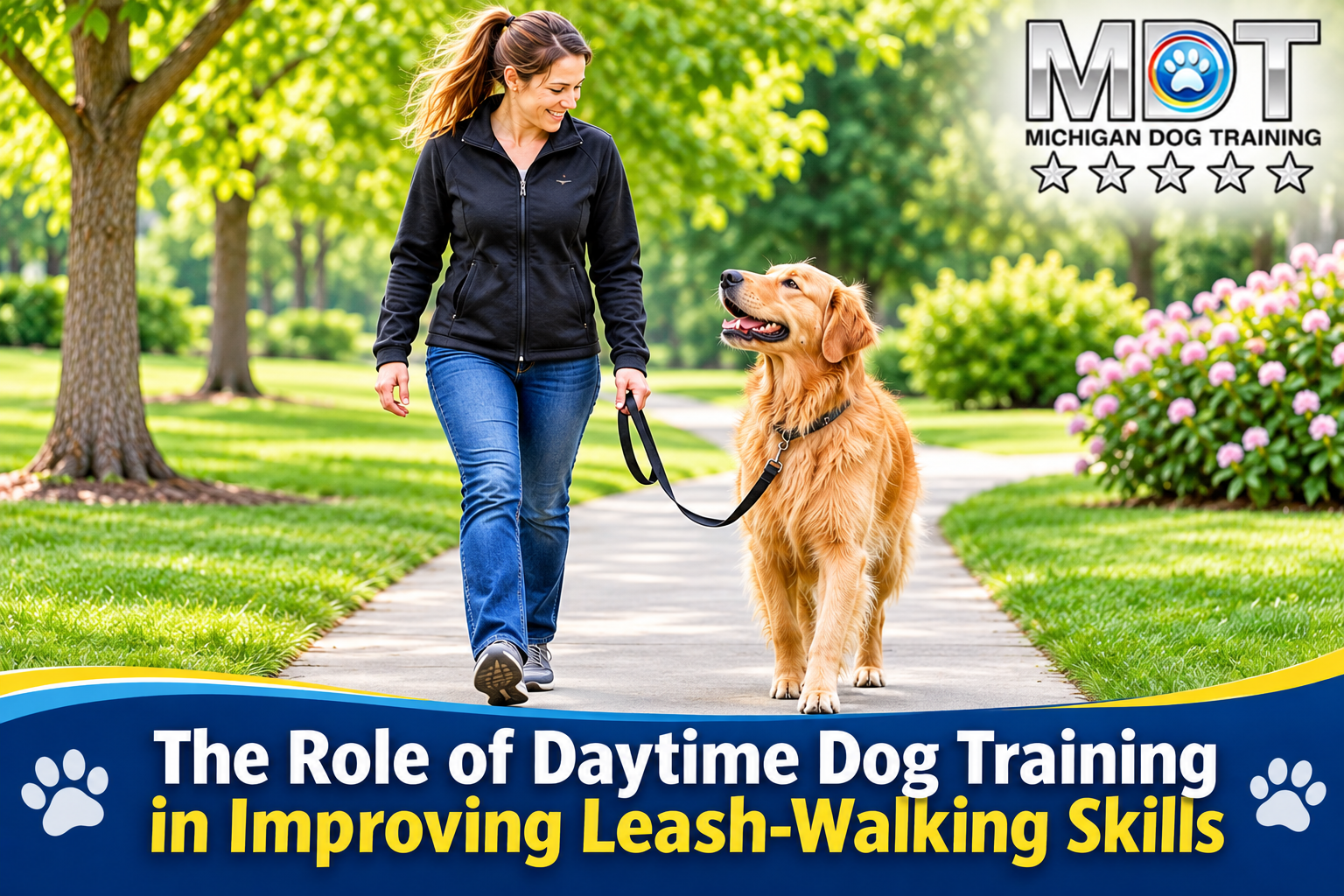
- Leash manners: Encouraging calmer walking without constant pulling or rushing toward distractions.
- Impulse control: Helping the dog pause and respond instead of immediately reacting to excitement.
- Place training: Teaching the dog to settle on a designated spot when visitors arrive, or household activity increases.
- Polite greetings: Reinforcing appropriate behavior around people rather than jumping or pushing for attention.
- Distraction management: Practicing familiar cues around people, other dogs, sounds, and everyday movement.
We tailor the training priorities to the dog’s age, temperament, previous experience, and the owner’s goals. A young puppy may need foundational manners, while an adult dog may need more practice with recall, leash behavior, or established habits.
How Can Owners Tell Whether a Training Program Is Effective?
Changes in the dog’s behavior are a better indicator of progress than the number of commands that are mastered. Owners should take notice of his or her dog’s consistency in responding to the various cues, the speed of recovery from distraction, and the ease with which daily routines are handled.
For instance, a dog that used to walk without a pause can start to walk with its handler more frequently. An overly hasty dog that charges at the front door might be trained to expect the person to wait for them. These changes demonstrate the impact training can have on your day-to-day activity.
We also feel that owners must be aware of the techniques employed. Learning is through rewards, communication, setting boundaries, and repetition. Owners should inquire with trainers about their approach to meowing, barking, fear, and reactivity issues before selecting a program.
Why Is Continued Practice Essential After Formal Training?
Training does not stop at the end of one class or intensive course. Dogs must be given experiences in which they can apply the skills and owners must be taught how to maintain the skills.
The American Veterinary Society of Animal Behavior advocates reward-based training which reinforces positive behavior and avoids the danger of aversive training. Owners are encouraged to use the same cue, reward for the correct response, and to build up to new challenges in a manner that is appropriate for their dogs’ ability.
Brief practice sessions can be seamlessly integrated into normal life. Owners may sit at a door or walk quietly before going for a morning walk, or settle down while the family is eating dinner. Practicing these behaviors over time will help them become part of the dog’s routine.
Why Is Personalized Training Becoming More Important?
Owners are increasingly seeing training of their pets as a proactive step towards good pet care, rather than only addressing serious behaviour issues. According to the American Pet Products Association, in its 2026 industry update, in 2025, some 95 million U.S. households had at least one pet, with some 71 million households owning dogs. This is a large pet-owning population, indicating the need for everyday practical guidance on care and behaviour.
We understand that all households are different. Some owners require assistance in raising a puppy, others may want better leash manners, a better recall or any help with more difficult behaviors. Recommendations are personalized to fit the situation rather than assuming that all dogs require the same type of training format.
Making Every Training Lesson Count
Reliable behavior develops through consistent practice, clear communication, and skills that transfer into everyday life. When owners understand how to reinforce those skills, training becomes an ongoing part of the relationship rather than a series of isolated commands.
Michigan Dog Training offers puppy and adult group classes, private lessons, day training, and board-and-train programs at its Plymouth, Michigan, facility, serving clients across Metro Detroit and the Ann Arbor region. For those researching dog training schools in Michigan or comparing options for dog training in Bloomfield Hills, MI, reviewing program formats and discussing individual goals can help identify a practical starting point.
Frequently Asked Questions
- At what age should dogs begin training?
We recommend beginning age-appropriate training early, using short, positive sessions that match each puppy’s development and attention span.
- How long does dog training usually take?
We adjust training timelines according to the dog’s needs, learning progress, behavioral history, and consistency of practice.
- Are group classes suitable for every dog?
We assess readiness carefully because group classes generally suit dogs comfortable around people and other dogs.
- Can older dogs learn new behaviors?
We can teach older dogs new skills by using consistent instruction, appropriate rewards, and gradual practice.
- How can owners maintain training results?
We encourage owners to practice regularly, reward desired behaviors, and apply consistent cues across everyday situations.